|
||||||||||||||
 |
 |
 |
 |
 |
 |
 |
 |
 |
 |
 |
 |
 |
 |
 |
 |
 |
 |
 |
 |
 |
 |
||||||||
|
|
|
|
|||||||||||||||||||||||||||||||||||||
| |||||||||||||||||||||||||||||||||||||||

|
|
||||
Building a custom wood fly fishing boat
|
|||||
Photos of the 16' Fly Fisher under construction |
|||||
The following photos show the construction process for these fly fishing skiffs.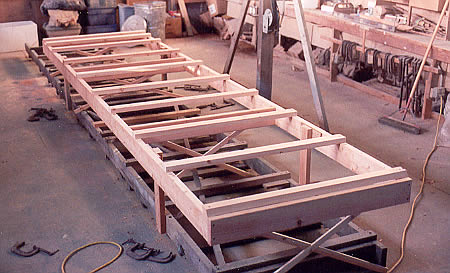 This construction sequence starts with building the ladder frame, on which we will set up the molds, transom, and stem. Since this is a small boat, we built the ladder frame on legs above a ladder frame for a larger boat. 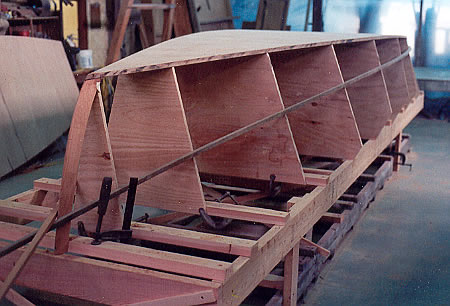 Since this will be a lapstrake boat, we'll build it over molds and put the frames in after the boat is planked and right side up. Then the frames can be jogged over the plank laps and fitted very precisely. Here we have the molds and stem clamped or screwed to the ladder frame, and the bottom plank installed on the setup. 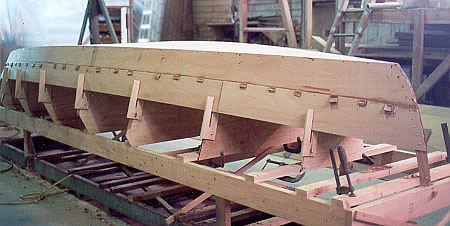 The process we will use to build this boat is called "glued plywood lapstrake." This means that all the planking is plywood, and it is all glued together to make a solid structure that won't shrink and swell or leak. In this photo, the garboard planks have been glued to the bottom plank. Next we glued on the second topside plank. Each plank will lap 3/4" onto the plank below it, and the pair of planks on both sides of the boat make up a strake, hence the term "lapstrake." 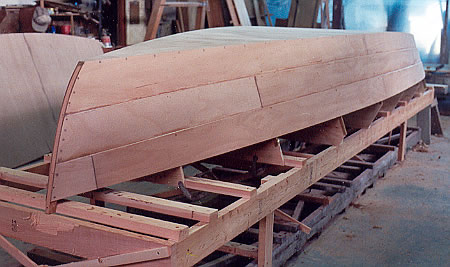 Here we see the planking finished. We made the planks all different widths on purpose. The boat will look very nice and boaty with the laps arranged the way we have done here. At the bow and stern, we've planed a "gain" into the lap of each plank so that the planking ends will lie flush with each other at both ends. That way the bow and stern won't have a stepped look to them. 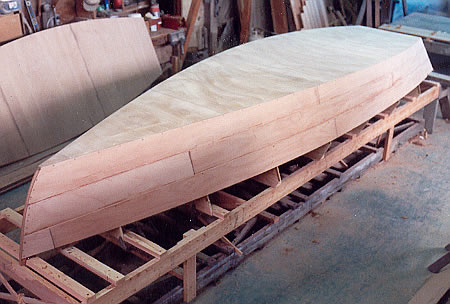 Here's the finished planking job seen from above. We are building two identical Fly Fishers for the same client. Hence the second bottom plank leaning against the workbench beyond the boat. Notice that the grain and scarfs in the bottom planks run athwartships, meaning at 90° to the length of the boat. We did that to make the bottom stiff enough to walk around on even though it will have no bottom frames. That will make a clean surface to strip fly line onto. 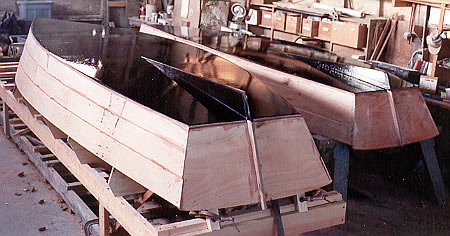 After we installed the skegs and sternposts, we coated the bottoms with a mixture of epoxy resin and graphite powder. The bottoms will not be painted. This specialized epoxy coating will make a very slick, durable, and rather scratchproof surface for skidding the boats up and down the beach. We'll also add a brass rub strip to the stem and skeg for additional protection. 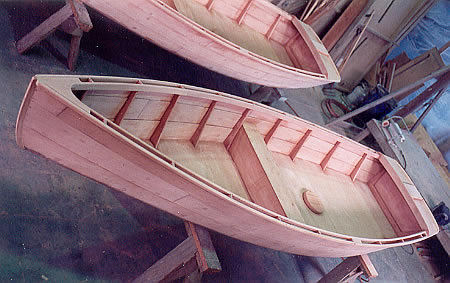 After we rolled the boats over, we installed frames, a center seat with flotation, a stern deck, two circular blocks to support pedestal seats, and finished the gun'l. 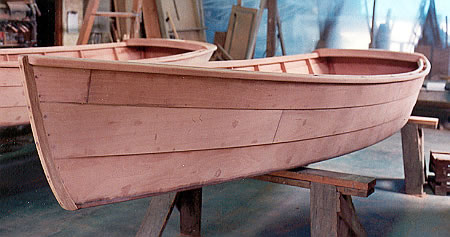 Here we see one of the boats from the bow. Nice sheer and plank lining, even if I do say so myself. 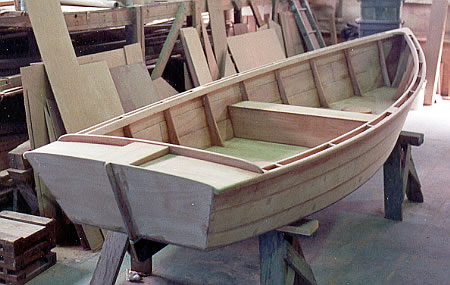 And from the stern. The stern deck will have an electric trolling motor mounted on it; one of those "bow mount" motors one sees on high powered bass boats. This one will mount properly on the stern and be remote controlled by the pilot sitting in his swivel chair. That's the life! The boats will be oiled with Cetol on the interior and painted Forest Green on the exterior. They look very nice all finished. We were in a big rush to get these boats on the truck for delivery and weren't able to get finished photos. |
We are located on the Snohomish River in the Pacific Northwest, about 20 miles north of Seattle.
Click here for a map to Nexus Marine Corporation.
| Home | The Boats | Boat Plans | About Nexus | Why Wood | FAQ | Links |
|
16' Flyfisher Home Fly Fisher Plans |